Can You Simulate Sous Vide Cooking With a Low Temperatue Pot of Water
posted by Dave Arnold
Low-Temperature and Sous-Vide Primer Contents:
- Purdy Pictures: Sous-Vide and Depression-Temp Charts
- I . Introduction to Low-Temperature Cooking and Sous-Vide
- **II. Depression-Temperature Cooking Without a Vacuum** you are here
- Three. Use and Abuse of the Vacuum Machine andVacuum Tricks
- 4. Temperature Control and Safety
- V. Cooking Meats and Poultry
- VI. Cooking Fish
- VII. Cooking Everything Else
Role II. Low-Temperature Cooking Without a Vacuum
… in which we'll discuss preparing foods for depression-temperature cooking without using a vacuum machine. We’ll await at zip-loc bags, plastic wrap, and cooking in oil/stock/humid air.
- i. Introduction: Why You'd Want to Do Depression-Temp Cooking Without a Vacuum
- 2. Unprotected Cooking Techniques
- 100% Humid Air
- Combi Ovens
- CVaps
- Cooking Directly in H2o/Fatty/Stock/Poaching Liquid
- Unprotected Cooking in Liquid
- Unprotected Cooking in Fat
- 100% Humid Air
- 3. Protected Low-Temperature Cooking
- Cooking in Plastic
- Packing Without the Vacuum
Ziploc Bagging
Wrapping in Plastic Wrap
- Rolling
- Cannonballs
Introduction
Before Nosotros Start: A Note from New York City:
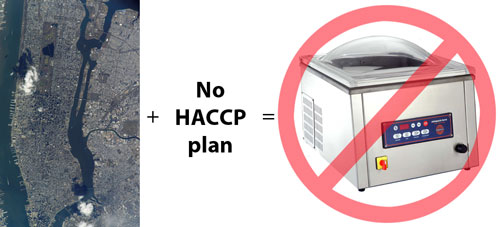
In New York City, a restaurant cannot employ a vacuum machine without developing a HACCP plan. HACCP (Run a risk Analysis Critical Control Points) is a system designed to ensure food rubber. It was adult by large corporations who were making food for space missions –giving an astronaut food poisoning tin can exist catastrophic. Creating your own HACCP plan (explained in the upcoming safety section of the primer), even if you lot don't implement it fully, is a nifty mode to help yourself ensure food condom. HACCP plans administered by the Board of Health, on the other hand, are a pain in the rear. They entail extra inspections, log books, lots of fourth dimension, and possibly spending coin on consultants. Look here for the Board of Health guidelines. Low temperature techniques that do not crave a vacuum machine have a major reward for New Yorkers: no HACCP plan required.
Even If You lot Don’t Melt in New York City:
While I beloved a commercial vacuum machine, well-nigh 90% of what a cook wants to reach with depression temperature cooking can be achieved without a vacuum machine. When Nils was at eating place Aquavit he did a lot of low-temperature work with a circulator, but didn’t have a vacuum car. Back and so restaurants weren’t required to have a HACCP plan; he didn’t have a commerical vacuum because they cost also much.
Today many home cooks use the Food Saver vacuum for low temp. I don’t utilize my Food Saver whatever more. I apply Ziploc bags, without a vacuum. I observe Ziplocs easier than the Food Saver â€" I don’t have to hunt down the special bags, I can easily handbag sauces (a pain with the Food Saver), I can pocketbook hot foods (foods to exist vacuumed need to be common cold – more on that in the side by side primer installment). My Nutrient Saver has been relegated to spud-chip-bag-resealer.
To Review:
Low temperature cooking is divers as any cooking procedure where the cooking temperature is at, or close, to the desired final internal temperature. There are two requirements for low-temperature cooking:
- precise and accurate temperature command
- a cooking medium which conducts rut more efficiently and accurately than dry air. H2o and water vapor are typical; oil, stock, or any other liquid will work (for more than info, run into Part I).
The Basics: To Pack or Not To Pack
There are ii bones approaches to low temperature cooking:
- Expose the food to the cooking environment â€" includes cooking in temperature controlled poaching liquids, oil, 100% boiling air. I call this “unprotected†depression temp.
- Protect the food from the cooking environment â€" includes vacuum bagging (covered in the next installment of the primer), Ziploc bagging, plastic wrapping.
2. Unprotected Cooking Techniques:
100% Humid Air
Yous can’t melt low-temperature in dry air; for example, don’t endeavour information technology in your oven. Dry air is a poor heat conductor and causes evaporative cooling at the surface of your nutrient â€" making accurate temperature control impossible. 100% boiling environments, like you can achieve in a combi oven, don’t conduct heat besides as direct water, only they tin can be very accurate. This kind of cooking is unproblematic. Nutrient goes into the cooker and gets pulled when it’s done; no wrapping required. The workflow is very intuitive for virtually cooks. But at that place are some disadvantages to 100% humid cooking; if you’re doing a cook-chill procedure the food isn’t protected from recontamination (information technology would be if it was wrapped); and during long cooking times (like several hours) the food’south surface tends to degrade.
Combi ovens and CVap ovens provide a 100% humid environs:
Combi Ovens
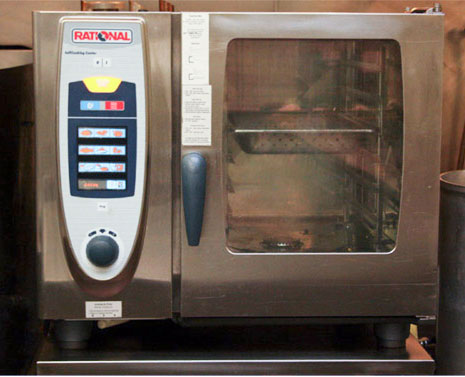
Combi ovens are combination steam/convection ovens; modern ones tin operate at depression temperatures. The chief advantage of combi ovens: they tin handle large amounts of food without getting bogged down by overloading, or by repeated opening and closing. Unfortunately, the ovens expend an enormous amount of energy to maintain this stability. Combis are also expensive and hard to retrofit into many kitchens. And perhaps their biggest problem: they aren’t very accurate. Studies by Chris Young and Nathan Myhrvold show that while a combi oven’south average temperature can be accurate to inside a couple of degrees centigrade, at whatsoever one moment it can exist tens of degrees off. Combis should simply exist used to melt large items , like roasts, that won’t overcook in the 10 minutes or so that it takes the combi to swing dorsum and forth around its target temperature.
CVap Ovens
CVap technology was originally adult for Kentucky Fried Craven. Colonel Sanders needed something that would concur his chicken in perfect condition; he asked his friend and fryer guru, Winston Fifty. Shelton, for help. In response, Shelton invented CVap (Controlled Vapor) technology. CVap ovens are basically food property cabinets with a bain marie in the bottom. Both the oven cavity and the bain marie are heated and temperature controlled. The cook tin control the humidity within the oven by adjusting the difference in temperature between the bain marie and the oven air. The cadre temperature of the food will not ascent higher up the temperature of the bain marie. The surface texture of the food is controlled by the humidity of the oven air. You gear up the temperature of the oven air much higher than the h2o for crispy foods, like fried chicken, and you set information technology the same temperature for depression temp cooking. For a detailed word of why the CVap works, run into hither.
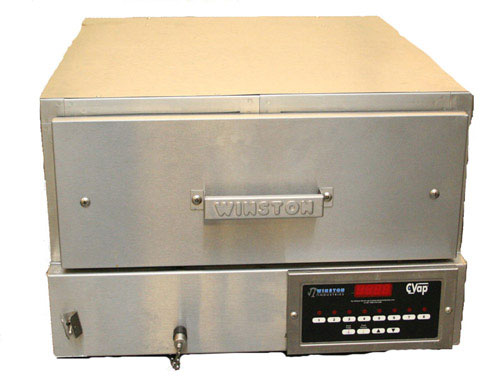
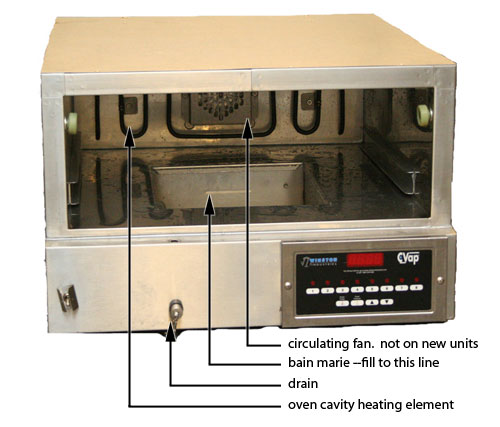
The Cvap comes in a range of sizes, is much cheaper than a combi, doesn’t crave a lot of power, doesn’t crave a water supply or a drain, and is extremely easy to retrofit. Many restaurants in New York City bought CVaps immediately afterwards the Health Department instituted HAACP control for sous-vide cooking. It is difficult to get a HAACP plan approved for sous-vide fish, and it is impossible to become one approved for fish beneath pasteurization temperatures (which is where nosotros normally want to melt it). Since the possibilities of low temperature fish attracted many chefs to low temperature cooking in the kickoff place, many took upward the CVap. It was basically unheard of in chef circles prior to the wellness department scissure down. The disadvantage of the CVap: it can outset sucking wind if overloaded, or if the door is frequently opened and airtight.
Cooking Straight in Water/Fat/Stock/Poaching Liquid
The immersion circulator is many cooks’ instrument of choice for low temperature cooking; nearly cooks only use their immersion circulator with water. Take note: y'all can circulate any liquid you want â€"stock, beer, oil, duck fatty, lard, apple cider, whatever. I am often asked if the circulator volition be damaged past liquids other than h2o. Happily, the answer is No. If you inquire Philip Preston from Polyscience (whose circulators nosotros use) he will tell you lot the machines aren’t NSF rated for direct food contact. It isn’t because the circulators aren’t prophylactic for direct food contact, it’s just that getting the NSF rating would cost a lot more money than information technology is worth. Here are the rules for unprotected cooking in the circulator:
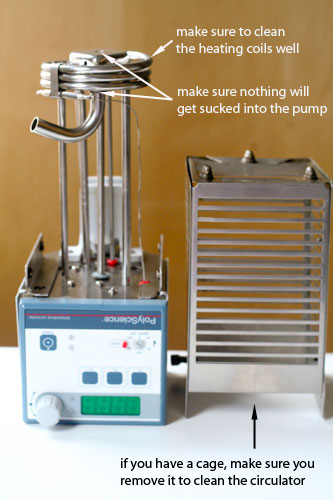
- Make sure the circulator is clean. Circulate detergent to clean it. Scrub the heating coils with a toothbrush. We use the oven cleaning tablets from our combi oven manufacturer to clean ours. Those tablets eat everything. Other people use CLR (calcium, lime, rust) remover. Exercise what you similar, only keep those circulators make clean.
- Make certain you aren’t going to suck small items into your circulator pump. Any fourth dimension you add herbs, burnt wood chips, crushed lobster shells, or whatsoever other flavoring to your bath, wrap it in cheesecloth first.
- Be careful, specially with oil and fat, to get proficient circulation. Bad circulation = bad temperature command and could = safety trouble. The cooking liquid should exist moving around all sides of the food at all times.
- Never cook unprotected in a liquid that isn’t hot enough to kill bacteria. We e'er continue our liquids higher up 54.4˚C (130˚F).
Unprotected Cooking in Liquid
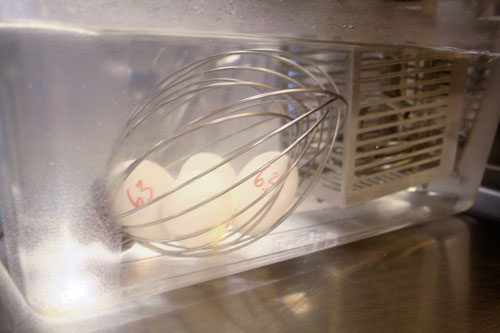
Eggs in their shells are cooked depression temperature in evidently h2o without any further protection â€"after all, they come up pre-wrapped. Most foods volition take their flavors leached out if cooked in h2o (that’s how goop is made) but some foods benefit from cooking in stock or other flavorful liquid. These foods are prime number candidates for unprotected low temperature cooking in liquid. Fish can be cooked in a temperature -controlled court-burgoo. Ham can be cooked in temperature-controlled apple cider. Bratwurst can be poached in temperature-controlled beer. Most of the time, you are ameliorate off putting a small amount of your flavorful liquid in a bag with your food and doing protected low temperature cooking — cooking directly in the liquid requires a lot of it. Here are some cases where cooking straight in liquid makes sense:
- If you take an item also big to bag easily, like a whole ham, that could also benefit from some added moisture and some mellowing (many hams are salty)
- If you lot are cooking many of the same particular over a flow of time â€"like sausages:
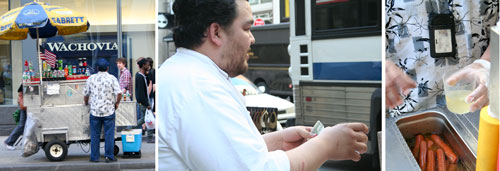
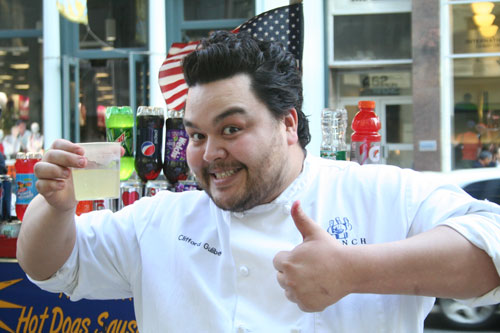
Let’s say you cook a couple hundred sausages a solar day. Get-go with a stock that complements your sausage. Employ an immersion circulator to go on that stock at 60˚C (140˚F). Throw raw sausages into the stock to cook every bit you lot need them and pull out the cooked ones to cease on the grill. Later on a couple of hours your stock will take on a gustatory modality nigh identical to your sausage. The stock will taste like liquid sausage. I verified this phenomenon past paying five bucks to drink a cup of cooking h2o from a New York City hot dog vendor. Later on your stock has reached the liquid-sausage stage it is no longer changing the flavor of your sausages. The stock and the sausages are in equilibrium. At the stop of the day, throw some water ice into your stock to cool it down and put it in the refrigerator. The adjacent solar day, bring your stock dorsum to the boil to impale bacteria and showtime again. If you added the correct amount of ice the day before (adamant by trial and error), yous should be able to maintain a constant corporeality of stock indefinitely. In China, stocks have been continuously maintained this way for hundreds of years.
Unprotected Cooking in Fat
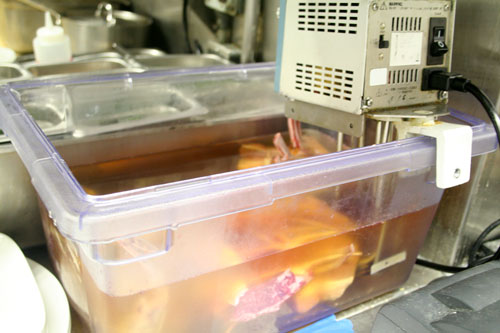
You can too cook directly in temperature controlled fat. Fat doesn’t leach the flavors out of food and often provides a benign unctuousness. It is expensive to fill a whole circulating bath with fatty, then utilise this technique in circumstances like these:
- Some chefs and customers adhere a stigma to cooking in plastic numberless; fat poaching, notwithstanding, has an aureola of tradition and wholesomeness
- If you are cooking a lot of the same item, it can be convenient to cook directly in fat. No time is required for bagging. Information technology's much faster to pull items directly out of a fat bath than to un-bag them. The price of the fat is less significant over a large number of items
- Very large items â€"like a 36 inch striped bass –tin can be difficult to bag, and you might not want their flavor altered by a stock. Cook them straight in oil or fatty.
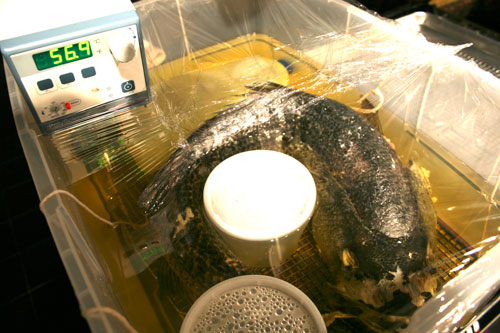
iii. Protected Low Temperature Cooking
Nearly low temperature cooking work involves protecting the food from the cooking medium with some sort of impervious embrace, which is almost invariably fabricated of plastic. The advantages of protected cooking are:
- There is no loss of flavor to the cooking medium.
- There is a reduced take chances of contamination.
- Different types of foods tin exist cooked in the same vessel at the same time.
- Protected foods are very piece of cake to chill quickly afterward they are cooked.
The main disadvantages to protected cooking are the time information technology takes to wrap or bag the nutrient, and some people’s trepidation almost cooking in plastic.
Cooking in Plastic:
Many people are concerned about the possibility of chemicals from plastics leaching into foods during cooking. I haven’t been able to get any firm data on the migration of plastic materials from bags and plastic wraps into food, but I’m fairly certain that at least a small amount of migration is probable to occur. Whether or not that degree of migration is harmful is up for fence.
Many people are currently worried almost the plasticizer Bisphenol A (BPA). Here is what the Us authorities has to say about it. BPA is used primarily in polycarbonate. While we don’t wrap foods in polycarbonate, low temperature cooking is often washed in polycarbonate containers (eg Lexans or Cambros).
Polyvinyl Chloride, another commonly used kitchen plastic , contains a whole mess of plasticizers â€"usually a group of chemicals chosen phthalates. As far equally the PVC manufacture is concerned, phthalates cause tumors in rodents merely non in primates â€"even in larger than normal doses. Other people are not so sure. Who knows? Many commercial plastic wraps are made of PVC. Often, these wraps odor bad â€"indicative of residual solvents and any is was used to make them. Aside from any purported wellness bug, bad smelling plastic wrap can most definitely make your food taste bad. Fat foods like cheese are more likely to pick upwards bad odors from plastic wrap. Don’t utilise plastic wrap that smells bad. On the positive side, PVC is a pretty good vapor and moisture barrier and can take pretty practiced heat resistance.
Polyethylene, in its many guises, is another major plastic used to wrap foods. Most supermarket plastic wrap is made from polyethylene (PE). Polyethylene is ordinarily plasticizer free â€"which is skillful news. Polyethylene wraps usually have some chemicals added to increase cling â€"ofttimes ethyl vinyl acetate (EVA) and polybutene (PIB). I haven’t found any wellness concerns on these two ingredients. The bad news most polyethylene is that it doesn’t tolerate very loftier temperatures and it is non a very skilful gas barrier. Plastic wrap is an particularly bad gas barrier because it is made from low density polyethylene (LDPE). Nutrient wrapped in LDPE will still oxidize. Odors might also be able to penetrate LDPE. Employ several layers. Ziploc numberless, equally far as I can determine, are usually made of polyethylene. The freezer Ziplocs are better gas barriers than standard Ziplocs, both of which seem better than plastic wrap. Perchance Ziplocs are only thicker than plastic wrap, maybe they contain some other type of polyethylene. I don’t know.
Packing Without the Vacuum:
Ziploc Bagging:
Ziploc bags are excellent cook-arctic tools. At the school we always call out Ziploc, rather than re-sealable bags, because many off-brands don’t work. The seals fail, the bags come apart when cooking, etc. Practise not purchase the Ziploc with the sliding practise-dad. Get the regular double-seal type. We buy the freezer storage numberless because they are supposed to act every bit a ameliorate vapor barrier than the regular type, and they are rated for re-heating in the microwave. We stock quart and gallon size bags. If you lot learn the proper technique for bagging, Ziploc numberless tin get almost as tight as a vacuumed purse.
The Technique:
- Fill a container with water deep enough to easily submerge your nutrient and bag.
- Always add together some sort of liquid to the bag â€"fat, stock, sauce, etc. The liquid is necessary to fill up the gaps around your food and miscarry the air from the bag.
- Add your food item. A significant reward of Ziplocs over vacuum bags is that the nutrient tin be added to the bag hot. All vacuum bagging procedures require your nutrient to be cold (more on that in the upcoming vacuum section of the primer). If you are searing meat and adding it straight to the Ziploc pocketbook make sure the surface of the meat is below 100ËšC (212ËšF) or the bag volition melt. Be especially careful to not touch the purse with a hot set of tongs or spatula.
- Close the seal of the pocketbook nigh to the edge, leaving the concluding portion of the seal open up â€"brand sure you take correctly sealed the bag. Put your finger in the corner to brand certain that office of the seal is open.
- Carefully immerse the handbag in the water starting with the closed corner, non the open one. Brand certain you do this stride carefully, allowing air to escape up and out of the open corner.
- Only as the open part of the seal is about to go under the h2o, close information technology up.
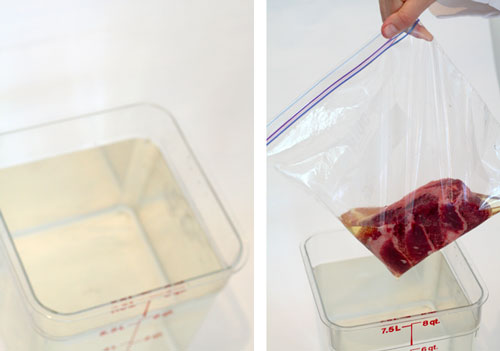
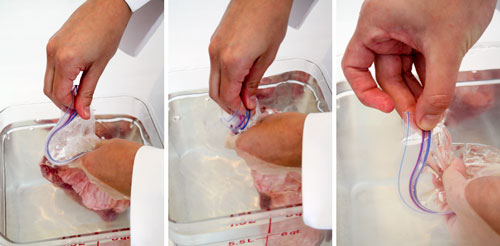
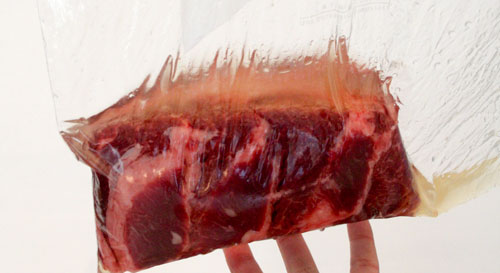
The advantages of the Ziploc are:
- yous don’t need to buy a vacuum
- food can be bagged hot
- food tin be removed from the bag and re-bagged easily
- the process is very gentle on foods and doesn’t modify nutrient textures the mode vacuum bagging can
- it'south just every bit effective for cooking as vacuum bagging for most items
The disadvantages of the Ziploc are:
- not as convenient for bagging a lot of items as the vacuum machine
- Ziplocs cost more than vacuum bags
- doesn’t provide some vacuum benefits â€"fast marination, extended storage, oxygen removal.
Wrapping in Plastic Wrap:
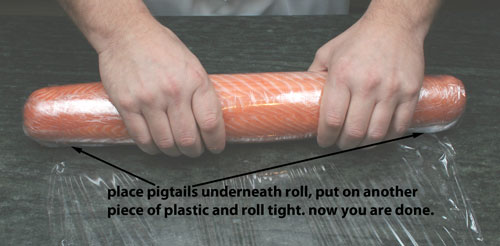
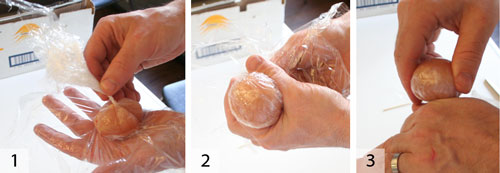
Rolling foods in plastic wrap is an fantabulous preparation technique for low temperature cooking. Rolls cook evenly and are easy to portion. We often combine rolling with some meat mucilage (see the transglutaminase primer). Properly rolled roulades in plastic wrap will non allow water to penetrate. Actually good rolls are dense â€"they will sink. Here is the technique in pictures, borrowed from our transglutaminase primer. Recollect â€"making good rolls isn’t as easy as it looks.
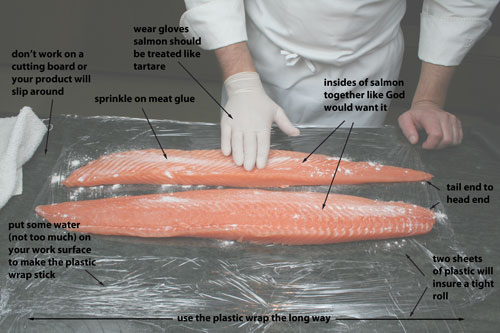
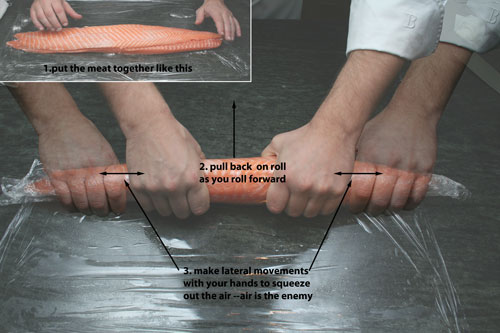
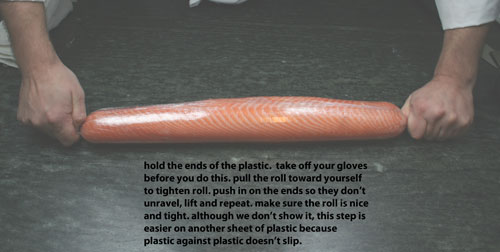
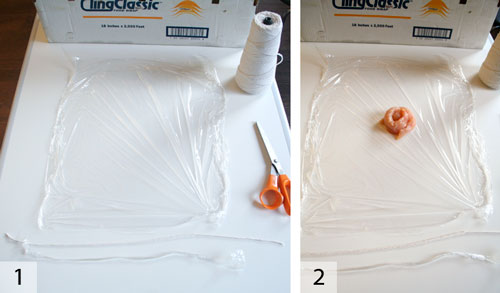
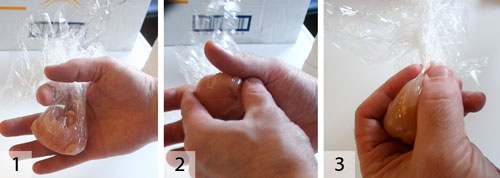
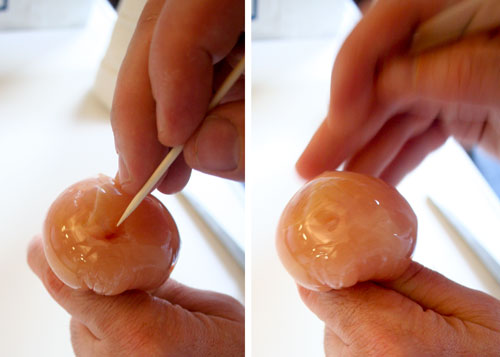
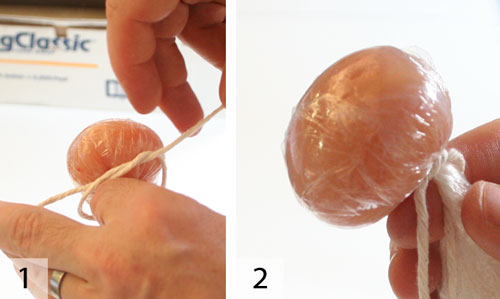
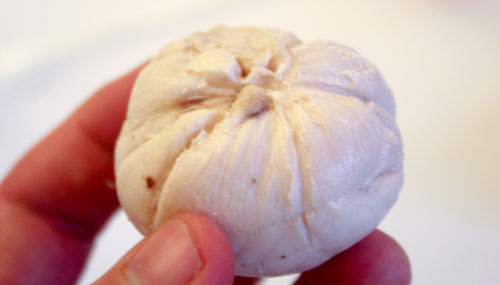
Another option for plastic wrapping: the cannon ball. Identify the food to be cooked in a square of plastic wrap and twist to form a brawl. Tie up the loose end. The office of the cannonball almost this loose end isn't going to be very pretty â€"serve information technology face up down on the plate.
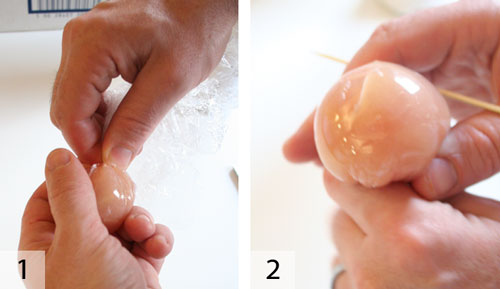
Whenever yous use plastic wrap, use a brand that doesn’t odor bad. If y'all are worried nearly phthalates, apply polyethylene instead of PVC.
Source: https://cookingissues.com/primers/sous-vide/part-ii-low-temperature-cooking-without-a-vacuum/
0 Response to "Can You Simulate Sous Vide Cooking With a Low Temperatue Pot of Water"
Post a Comment