Which Style of Painting Is the Peale Family Known for?
| Rembrandt Peale | |
|---|---|
 Rembrandt Peale, Cocky-portrait | |
| Built-in | (1778-02-22)February 22, 1778 Bucks Canton, Pennsylvania |
| Died | Oct 3, 1860(1860-10-03) (anile 82) Philadelphia, Pennsylvania |
| Nationality | American |
| Didactics | Paris (1808), (1809–1810), Britain (1832) |
| Known for | Artist |
| Notable piece of work | Rubens Peale with a Geranium, George Washington, Patriae Pater, Court of Death |
| Movement | Neoclassical |
| Patron(south) | Charles Willson Peale, George Washington, Thomas Jefferson, Rubens Peale, John Marshall, John C. Calhoun, Charles Mathews, Jean-Antoine Houdon, DeWitt Clinton, Thomas Sumter |
Rembrandt Peale (Feb 22, 1778 – October iii, 1860) was an American artist and museum keeper. A prolific portrait painter, he was specially acclaimed for his likenesses of presidents George Washington and Thomas Jefferson. Peale's style was influenced by French Neoclassicism later a stay in Paris in his early on thirties.
Biography [edit]
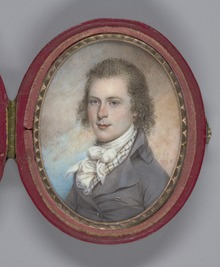
Miniature of Rembrandt Peale in 1795, by his uncle, James Peale
Rembrandt Peale was born the tertiary of half-dozen surviving children (11 had died) to his mother, Rachel Brewer, and father, Charles Willson Peale, in Bucks Canton, Pennsylvania, on February 22, 1778. The male parent, Charles, also a notable creative person, named him subsequently the noted 17th-century Dutch painter and engraver Rembrandt Harmenszoon van Rijn. His father also taught all of his children, including Raphaelle Peale, Rubens Peale and Titian Peale, to paint scenery and portraiture, and tutored Rembrandt in the arts and sciences. Rembrandt began drawing at the age of eight. A yr after his female parent'due south decease and the remarriage of his father, Peale left the school of the arts, and completed his showtime cocky-portrait at the age of xiii. The sail displays the young artist'due south early mastery. The clothes, however, requite the notion that Peale exaggerated what a 13-yr-old would look similar, and Peale's hair curls like the hair of a Renaissance angel. Later in his life, Peale "oft showed this painting to young beginners, to encourage them to become from 'bad' to better..."[one]
In July 1787, Charles Willson Peale introduced his son Rembrandt to George Washington, and the young aspirant creative person watched his father paint the future president. In 1795, at the age of 17, Rembrandt painted an crumbling Washington, making him appear far more aged than in reality. The portrait was well received, and Rembrandt had made his debut.
At the age of 20, Peale married 22-yr-quondam Eleanor May Short (1776–1836) at St. Joseph'due south Cosmic Church building in Philadelphia.[2] During their marriage, Peale and Short had nine children: Rosalba, Eleanor, Michael Angelo, Angelica, and Emma Clara among them. In 1840, he married Harriet Cany (1799–1869), ane of his pupils and an artist in her own right.[three]
In 1822, Peale moved to New York City, where he embarked on an effort to paint what he hoped would get the "standard likeness" of Washington. He studied portraits past other artists including John Trumbull, Gilbert Stuart and his own begetter, besides as his own 1795 picture which had never truly satisfied him. His resulting piece of work Patriae Pater, completed in 1824, depicts Washington through an oval window, and is considered past many to exist second only to Gilbert Stuart's iconic Archives painting of the first president. Peale afterward attempted to capitalize on the success of what quickly became known as his "Porthole" picture. Patriae Pater (Latin for "Father of Our Country") was purchased by Congress in 1832 for $2,000. Information technology currently hangs in the Former Senate Chamber.[iv]
In 1826 he helped found the National University of Design in New York City.
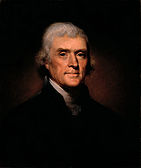
Peale went on to create over lxx detailed replicas, including one of Washington in full military uniform that currently hangs in the Oval Office. Peale continued to paint other noted portraits, such every bit those of the third president Thomas Jefferson while he was in function (1805), and later on a portrait of Primary Justice John Marshall.
Travels [edit]
Noted for his "itinerant" nature, Peale visited Europe several times to written report art (Ward). Throughout his life, Peale traveled beyond the western hemisphere in search of inspiration and opportunities as an creative person. His father helped pay his manner to Paris, where he stayed from June to September 1808, and again from October 1809 to November 1810. In Paris, Peale studied the works of Jacques-Louis David, which influenced him to paint in the Neoclassical style. He painted the famous explorer Alexander von Humboldt and several other noted patrons such every bit Joseph Louis Gay-Lussac and François André Michaux. After his successes in France, Peale returned to Philadelphia in 1810.
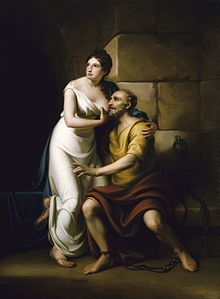
His efforts to institute his knowledge and mastery of fine art were displayed in his painting The Roman Daughter (1811). The painting depicts a young girl shielding her father, a prisoner in chains, and feeding him from her breast, the emblem of "Roman Charity" reported in the pages of Pliny. It was deemed besides "sensational" by the people of Philadelphia,[five] who were unsympathetic to his endeavors toward "improving the state of fine arts in America" in the 19th century.[6] Amid the economic hardship of the State of war of 1812, President Jefferson—who promised to buy the 1795 portrait of Washington, but could not go on his hope—instead encouraged Peale to go to Europe, as "we have genius among united states of america only no unemployed wealth to reward it".[7]
Peale's Baltimore Museum [edit]

Motivated by his father's establishment of the American Museum of Philadelphia (1786) and having been unsuccessful in Philadelphia, Rembrandt Peale causeless his father's role in another city. On August 15, 1814, Peale launched his starting time museum as before long equally he arrived in the municipality of Baltimore, Maryland on Holliday Street between East Saratoga and Lexington Streets, the first building constructed in America to serve as a museum. Information technology later served as the 2d Baltimore City Hall, 1830–1875; a "Colored" master, grammer, and high schoolhouse, part of Baltimore'south segregated public schoolhouse system, 1878–1889; and was restored in 1931 as the Municipal Museum of the Urban center of Baltimore. Renovated and restored again in 1981, it reopened with a groundbreaking interpretive history exhibition, "Rowhouse: A Baltimore Style of Living." In 1985, the Municipal Museum, which had grown to five sites (Peale Museum, Carroll Mansion, 1840 Business firm, Baltimore Heart for Urban Archæology, and H.50. Mencken Business firm) was renamed Baltimore Metropolis Life Museums. It airtight in 1997, a year later on opening a new 30,000sf exhibition center.
The museum was elaborately illuminated by gas light, following the instance of his blood brother Rubens in Philadelphia. This innovation fabricated a great impression. Peale had acquired an important gas lighting patent, and with some associates founded the successful Gas Low-cal Company of Baltimore. Having poor business concern sense, though, he did fiddling to manage the company and was forced out after a few years due to the War of 1812.[8] [9]
In 1828, an ambitious Peale raised funds and tried earning money for his previous paintings, in order to travel to Rome. He took along his fifteen-year-erstwhile son, Michael Angelo, a determined young artist who copied his father'south paintings in admiration.[x] Peale successfully displayed portraits of Horatio Greenough and Washington every bit Patriæ Pater in the Florentine university.
Peale died June 12, 1860, in Philadelphia and is buried at Woodlands Cemetery in Due west Philadelphia.
Works [edit]

"The oldest living American artist", Detail of a photograph of Rembrandt Peale taken past Mathew B. Brady
Exhibited and discussed in "In Pursuit of Fame: Rembrandt Peale 1778–1860," Washington D.C., National Portrait Gallery, Smithsonian institution, 1992–93, The portrait of Margaret Irvine Miller exemplifies Peale'southward ability to convey a story and capture graphic symbol through taking liberty with the manner in which he portrayed his sitters. Mrs. Miller, by nascency working-class, afterward raised her position in Philadelphia club. Though her clothing is aristocratic, Mrs. Miller's pose and gaze are those of a straightforward, working-class adult female. The subtle juxtaposition is masterfully captured in the finest of terms.
In 1801, Peale painted a portrait of his brother Rubens, youngest of the six Peale children, who always had an admiration for gardening and tending to natural life. Peale seated his brother next to a geranium. The painting signifies the creative person's admiration for a sibling's dearest of nature, and may have been inspired by the Dutch 17th-century artist, David Teniers the Younger, who had painted a series of oil-on-copper paintings representing the 5 senses. His painting, Smell is quite similar to Rembrandt Peale's. Rembrandt's piece captures the essence of a young gardener/artist'due south peace of mind, gracefully looking out, a posture of wonder and calmness.[eleven]
In 1824, Peale painted the Patriæ Pater, in which a rectangle supporting an oval wreath surrounds the eye-catching prototype of George Washington. The nearly successful painting of Peale's fifty-twelvemonth career, information technology inspired John Marshall to have his portrait done past Peale in the same manner. The painting was criticized as lacking actuality, as it was non completed until after Washington's decease (1799). Nonetheless, Peale received commendations for his portrait by many noted politicians such as Washington's nephew, Estimate Bushrod Washington, who was an acquaintance U.S. Supreme Court Justice, and Marshall.[12]
Peale's neoclassical painting The Roman Daughter demonstrates compassion and graceful defense; his copy of Correggio'southward Angel, and his immense allegorical painting, Courtroom of Death (1820), reveal the aforementioned artistic manner.
Legacy [edit]

Portrait of George Washington (1795–1823)

Ballou's Pictorial, Volume Thirteen, October 17, 1857
Rembrandt Peale completed more than than 600 paintings. He painted portraits of many notable people, including American presidents George Washington and Thomas Jefferson,[xiii] Chief Justice John Marshall,[14] and John C. Calhoun. His paintings are in many public collections.
Collections [edit]


Portrait of Edward Shippen Burd of Philadelphia (ca. 1806–1808)
The following is a fractional list of collections property works by Rembrandt Peale:
- Washington, D.C.: National Museum of American Fine art and National Portrait Gallery, The Smithsonian Institution
- Baltimore, Maryland: The Peale Museum, Baltimore Museum of Art, Maryland Historical Society, Walters Art Museum
- Philadelphia, Pennsylvania: The Historical Social club of Pennsylvania, Atwater Kent Museum, Pennsylvania University of Fine Arts
- Detroit, Michigan: Detroit Institute of Arts
- Columbus, Georgia: The Columbus Museum
- Birmingham, Alabama: Birmingham Museum of Art
- New York: Brooklyn Museum, The Peale Museum of New York
- New London, Connecticut: Lyman Allyn Art Museum
- Dallas, Texas: The Dallas Museum of Art Modern American Collection
- Pittsfield, Massachusetts: Berkshire Museum
- Philadelphia, Pennsylvania: La Salle University Art Museum[15]
- Wilmington, Delaware: Hagley Museum and Library
Other notable paintings [edit]
- Charles Willson Peale, Historical Society of Pennsylvania, Philadelphia, 1812
- Washington Before Yorktown, Corcoran Gallery of Art, 1824
- John C. Calhoun, Gibbes Museum of Fine art, 1834
- The Sisters, Eleanor and Rosalba Peale, A. Augustus Healy Fund, Brooklyn Museum, 1826
- General Thomas Sumter, Independence National Historical Park, Philadelphia, 1796
- Mrs. Marbury, Private Drove, 1797
- Sculpture, Atwater Kent Museum, Philadelphia, c. 1812
- DeWitt Clinton, Historical Society of Pennsylvania, Philadelphia, 1823
- Mary Jane Peale, Elise Peale Patterson de Golpi-Toro, New York, 1835
- Eleanor May Curt Peale, Individual Collection, 1836
- William Henry Harrison, Grouseland (William Henry Harrison House), Vincennes, IN
A portrait identified [edit]
A painting of a comedian who was an acquaintance of the British painter George Clint—an artist whose way resembled Peale's, and who claimed the picture every bit his own—was examined by the National Portrait Gallery of London in 1914. Information technology was initially confirmed as Clint'southward artwork. Later, the gallery farther examined the history backside the painting: the English comedian, Charles Mathews, had arrived in New York in 1822, and left shortly after Peale had welcomed him for a portrait painting.[sixteen]
Gallery [edit]
-

Working Sketch of the Mastodon (1801)
-
-

Samuel Fisher Bradford (1803–1808)
-

Albert Gallatin (1805)
-

Portrait of Margaret Irvine Miller (1805)
-
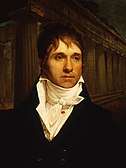
Portrait of William Short (1806)
-

Portrait of Henry Robinson (1806–1808)
-

Portrait of Rubens Peale (1807)
-

Alida Livingston Armstrong and Girl (c. 1810)
-
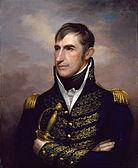
-

Portrait of Jacob Gerard Koch (ca. 1817)
-
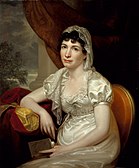
Portrait of Jane Griffith Koch (ca. 1817)
-

Full general Samuel Smith (ca. 1817)
-

-

-

-

-

-
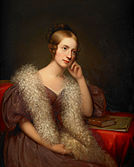
Caroline Louisa Pratt Bartlett (1836)
-

Niagara Falls (1849)
-
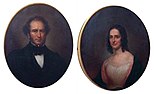
Portraits of Richard Colgate Dale Jr and Elizabeth Woodruff Dale (1857)
Notes [edit]
- ^ Miller, Lillian B. Rembrandt Peale: A Life in the Arts: 1778–1860. The Historical Gild of Philadelphia, Philadelphia, 1985
- ^ Miller, Lillian B. Rembrandt Peale: A Life in the Arts: 1778–1860. The Historical Order of Philadelphia, Philadelphia, 1985, pp. 80–81
- ^ Chrysler Museum at Norfolk; Anderson, Dennis R (1976). Three hundred years of American fine art in the Chrysler Museum: a selected exhibition from its permanent collection honoring the nation'due south bicentennial and the completion of the museum's new twenty gallery structure. Norfolk, Va.: The Museum. p. 24. OCLC 219774214.
- ^ U.S. Senate Art & History, A Finding Help to the Rembrandt and Harriet Peale Drove, c. 1820–1932.
- ^ Miller, Lillian B. Rembrandt Peale: A Life in the Arts: 1778–1860. The Historical Social club of Philadelphia, Philadelphia, 1985, p. 15
- ^ Mahey, John A. "The Studio of Rembrandt Peale." American Fine art Journal, Vol. 1, No. 2. (Autumn, 1969), pp. 20–40
- ^ Ward, David C. "Celebration of Cocky: The Portraiture of Charles Willson Peale and Rembrandt Peale, 1822–27." American Art, Vol. 7, No. 1. (Winter, 1993), p. 17)
- ^ Hunter, Jr., Wilbur H. "Peale'south Baltimore Museum." College Fine art Journal, Vol. 12, No. 1. (Fall, 1952), pp. 31–36.
- ^ "EH.Cyberspace Encyclopedia: Manufactured and Natural Gas Industry". Archived from the original on Jan 2, 2008.
- ^ Miller, Lillian B. Rembrandt Peale: A Life in the Arts: 1778–1860. The Historical Social club of Philadelphia, Philadelphia, 1985, p. 72
- ^ Soltis, Carol Eaton. "Rembrandt Peale'southward Rubens Peale with a Geranium: A Possible Source in David Teniers the Younger". American Art Periodical, Vol. 33, No. one/2. (2002), pp. iv–19
- ^ Ward, David C. "Celebration of Self: The Portraiture of Charles Willson Peale and Rembrandt Peale, 1822–27." American Art, Vol. seven, No. one. (Winter, 1993), pp. eight–27.
- ^ http://sirismm.si.edu/saam/scan2/P36360656_b.jpg [ dead link ]
- ^ "John Marshall Portrait". oyez.org. Archived from the original on April x, 2008.
- ^ http://www.lasalle.edu/museum/index.php?section=listings [ expressionless link ]
- ^ "Meschutt, David." "Rembrandt Peale'due south Portrait of Charles Mathews, British Comedian, Identified." American Fine art Journal, Vol. 21, No. 3. (1989), pp. 74–79.
References [edit]
- Hunter, Jr., Wilbur H. "Peale's Baltimore Museum." Higher Art Periodical, Vol. 12, No. 1. (Autumn, 1952), pp. 31–36
- Mahey, John A. "The Studio of Rembrandt Peale." American Art Journal, Vol. 1, No. 2. (Autumn, 1969), pp. 20–40.
- Meschutt, David." "Rembrandt Peale's Portrait of Charles Mathews, British Comedian, Identified." American Art Journal, Vol. 21, No. three. (1989), pp. 74–79.
- Miller, Lillian B. Rembrandt Peale: A Life in the Arts: 1778–1860. The Historical Society of Philadelphia, Philadelphia, 1985
- Soltis, Carol Eaton. "Rembrandt Peale's Rubens Peale with a Geranium: A Possible Source in David Teniers the Younger". American Art Journal, Vol. 33, No. 1/2. (2002), pp. iv–19
- Ward, David C. "Celebration of Self: The Portraiture of Charles Willson Peale and Rembrandt Peale, 1822–27." American Art, Vol. 7, No. 1. (Winter, 1993), pp. viii–27.
External links [edit]
- The Rembrandt And Harriet Peale Papers, 1824–1932 have been digitized and posted online by the Archives of American Art, Smithsonian Institution.
- Rembrandt Peale on Artcyclopedia.com
- Rembrandt Peale at Find a Grave
- Rembrandt Peale Gallery
Source: https://en.wikipedia.org/wiki/Rembrandt_Peale
0 Response to "Which Style of Painting Is the Peale Family Known for?"
Post a Comment